Soft Skills Are The Game Changer: How To Show Them Off

To select the leader for their next engagement, more and more clients are reviewing professional profiles online. They are not just looking for good technical people anymore, they want to know how you interact with others (are you a team player? a good communicator?). A recent LinkedIn article said that “degrees and credentials are important, but the development of soft skills—skills that are more social than technical—are in high demand.” Soft skills are the game changer when it comes to finding your next project. Being able to show you know how to use them makes a big difference between landing the role or not.

A degree or certificate proves hard skills.

How does one even show soft skills online or on their resume? Let’s discuss the balance between the two types of skills (hard and soft) and then I will give you some tips on how to include them in your digital profiles.


Hard Skills Gets You In The Door

Hard skills are easy to define and measure. That’s why resumes are full of them. They are how you do something: a procedure, a best practice, a method. They are proven by the measurement of training and knowledge that you acquire in a specific skill set (PMP certification or Bachelor of Science degree, for example). You spend years learning hard skills in school or on the job (i.e.: machine operations, computer programming, data analysis, a foreign language).

Hard skills are controlled by the left side of your brain. This side controls logic and your ability to perform a task. Common left brain professions are Mathematicians, Statisticians, Computer Programs and, of course, Project Managers. PMs usually have a long list of hard skills that they are good at – strategic planning, requirements analysis, Waterfall development methodology, building work break down structures, and so on.  I am sure your resume is full of good details on your hard skills.
 Soft Skills Gets You The Position

Soft Skills are your personality qualities, habits, attitudes, and even social graces. Unlike hard skills, which can be evaluated by a logic intelligence test (IQ), soft skills tend to use your heart and are evaluated by an emotional intelligence test (EQ). This is right brain stuff – artistic, creative. This is where you solve problems. These skills are harder to measure and difficult to prove.

Some examples of soft skills are: anticipating risk, motivating others, teamwork, innovating, listening, communicating. They are things that you hone and improve with a lifetime of trial and error. They are subjective. These are the skills that make you unique in how you do what you do. You can take classes to develop these skills, but it is your innate personality and strengths that ultimately determine which soft skills you excel in.

Clients today are looking for project leaders that understand organizational values, excel in teamwork and communications, and know how to leverage their personal strengths to maximize project results. The challenge is to show not only that you have certain soft skills, but how they have and will bring value to your role.

Showing Your Value

Before you can show the value of your strengths, you need to identify what they are. There are many EQ tests and online tools that can assist you with evaluating your soft skills. Here’s a list of 28 soft skills to get you started. These life skills are the things that add value to how you work. This is what clients want to know about you – what makes you unique.

A partial list of soft skills strengths.

The way to show that you know your stuff is by using narrative (by storytelling) on your profile and resume. Take leadership, for example, someone won’t know how you applied leadership if it is just a bullet on your resume but show it in connection with a situation, and they will clearly see how you applied it.

According to Jessica Hernandez, CEO of Great Resumes Fast, the way to show your value is by incorporating the skill within the context of an accomplishment that demonstrates it.

Here’s an example:

  •  “Increased productivity of a multi-year software development project by 10 percent by improving communications across geographically dispersed teams and the stakeholder groups.”

What client wouldn’t want a project manager who could increase the productivity of the team? This bullet is impressive because it shows that the PM used her communications and teamwork skills in the context of a real client situation.

You can incorporate soft skill evidence into almost any narrative in this way.

Tell Your Story

According to career expert, Alison Doyle, “Integrating storytelling elements into resumes … can help to paint a dynamic picture of achievement.” Using story rather than a bullet list of skills on your profile and resume shows the reader that your focus is on HOW you improved a business situation, not just WHAT you did.

Don’t be afraid to tell your story, incorporate your soft skills, and show them you are capable and ready for that next great project.

Feel free to comment below and I’ll do my best to answer your questions about leveraging hard and soft skills to enhance your digital reputation. Until next time, keep up the good attitude.


Everything You Need to Know About Project Life Cycles

Project Management life cycles explained, based on PMBOK© Guide Sixth Edition

When dancing, if you start off on the wrong foot, you may never recover. Sadly, the same can happen if you pick the wrong lifecycle approach for your project. With the wrong approach, you run the risk of cost overruns, long delivery delays, and potentially a failed project. Luckily, there are several project life cycle approaches available to help you control and deliver your projects successfully. This post will explain the current life cycle approaches based on the recently updated A Guide to the Project Management Body of Knowledge (PMBOK ®  Guide – Sixth Edition) and how they affect project constraints.

What is the project life cycle?

The project life cycle contains every phase that your project goes through from beginning to end (cradle to grave). Some projects may have only one phase, others may have many. The PMBOK ®  Guide – Sixth Edition defines the project life cycle as “the series of phases that a project passes through from its initiation to its closure.” (page 19). That seems simple enough.

What is a phase?

Per the definition, every project is made up of one or more phases, which are “a collection of logically related project activities that culminate in the completion of one or more deliverables” (page 20). Phases can be sequential (back-to-back), iterative (cyclic) or overlap (simultaneous at points). The more phases and the more overlap, the greater the risk to the constraints of time, scope, and cost.

What is the life cycle approaches?

The PMBOK ®  Guide directly calls out two life cycle approaches: predictive and adaptive. Then it subdivides the adaptive life cycle approach into multiple phases that they call development life cycles:

  • Predictive
  • Iterative
  • Incremental
  • Adaptive
  • Hybrid

To help me decide what approach to use for a particular project, I focus on how the life cycle approach handles the project requirements, constraints, stakeholder feedback, and resources.

What is the generic life cycle?

Rarely is anything generic, but the PMBOK ®  Guide defines four generic phases in a lifecycle as

  1. Starting the project
  2. Organizing and preparing
  3. Carrying out the work
  4. Ending the project

(Figure 1-5 from page 18). The important things to know about this generic life cycle are:

  • Cost and staffing levels will continue to increase until they peak while carrying out the work
  • Risk and uncertainty will decrease over time
  • Cost of changes significantly increases over time

“All projects can be mapped to the generic life cycle” (page 19), so make sure to know them if you are going to take the PMP® exam.

Why do I care about the different types of life cycle approaches?

When there was only one approach, Waterfall, we needed to develop workarounds and try to contain and control everything within that fixed model (what a challenge). Today, with multiple approaches available, you can find the most flexible, cost-effective, time-sensitive way to deliver (what a relief). Below I detail the approaches mentioned in the PMBOK ®  Guide – Sixth Edition, but there are dozens more you can investigate and choose from, each having their own benefits and drawbacks.

Predictive Life Cycle (Fully Plan-Driven aka Waterfall) – During the previous 30 years of the last millennium (the ’70s, ‘80s, ‘90s), the Waterfall approach was the gold standard for all projects. It is a fully plan-driven approach where the 3 main project constraints (time, scope, cost) are all determined at a detailed level at the start of the project. You need to know your requirements going in and the scope is fixed at the onset. Each phase is then laid out sequentially and managed carefully.

Over time, to allow for more precise planning, the approach has allowed for “progressive elaboration” or “rolling wave planning” (page 185). Remember that scope and planning are two different things. Progressive elaboration doesn’t change the scope. It allows you to roll out the schedule into shorter passes. I measure all other approaches against the benefits and failings of this traditional approach (maybe because it is the first one I learned). Waterfall was great when I managed the very controlled and predictive development of a new hard drive at IBM. The project spanned years and didn’t require much stakeholder involvement (mostly at beginning and end or when we had scope changes that needed approval). The downside is that Waterfall is pretty inflexible when it comes to changes late in the project and therefore leads to significant cost increases when rework is needed. This is why I believe people started coming up with more adaptive approaches.  But Waterfall is still a good lifecycle approach if you have the development time and you know what you want to deliver. Don’t disregard its benefits.

Iterative Life Cycle – As timeframes for delivery got shorter and requirements got less clear, we needed additional lifecycle approaches that could handle the changes faster and less expensively. We found that when you broke large and complex projects down into smaller phases (aka cycles) it gave us more control (decreased risk and cost of rework). As the name implies, you execute the project in small iterations, giving you the ability to better define requirements at the start of each cycle. The PMBOK ®  Guide (page 19) recommends that you still define scope early in the project, but that you modify time and costs after each iteration since you will understand them better.

The iterative approach is like a bunch of small waterfall cycles with the customer verifying the work at the exit of each cycle. This gives you more flexibility and a better opportunity to address changes and reduce risk. You detail the scope for the next phase when you are done with the previous. I’ve used the iterative lifecycle approach when developing software updates. My iterations spanned 3 or 4 months at a time as part of a longer project.

Incremental Life Cycle – Many times you will see the incremental approach grouped with the iterative. They are similar but also different. The incremental lifecycle approach develops a product through the implementation of incremental steps which have predetermined timeframes. Each increment delivers additional functionality for the product and is repeated until the final deliverable is produced. Like with the iterative approach, customers signoff at each exit point. This approach is great when you want to do prototyping and reduce change risk along the way.

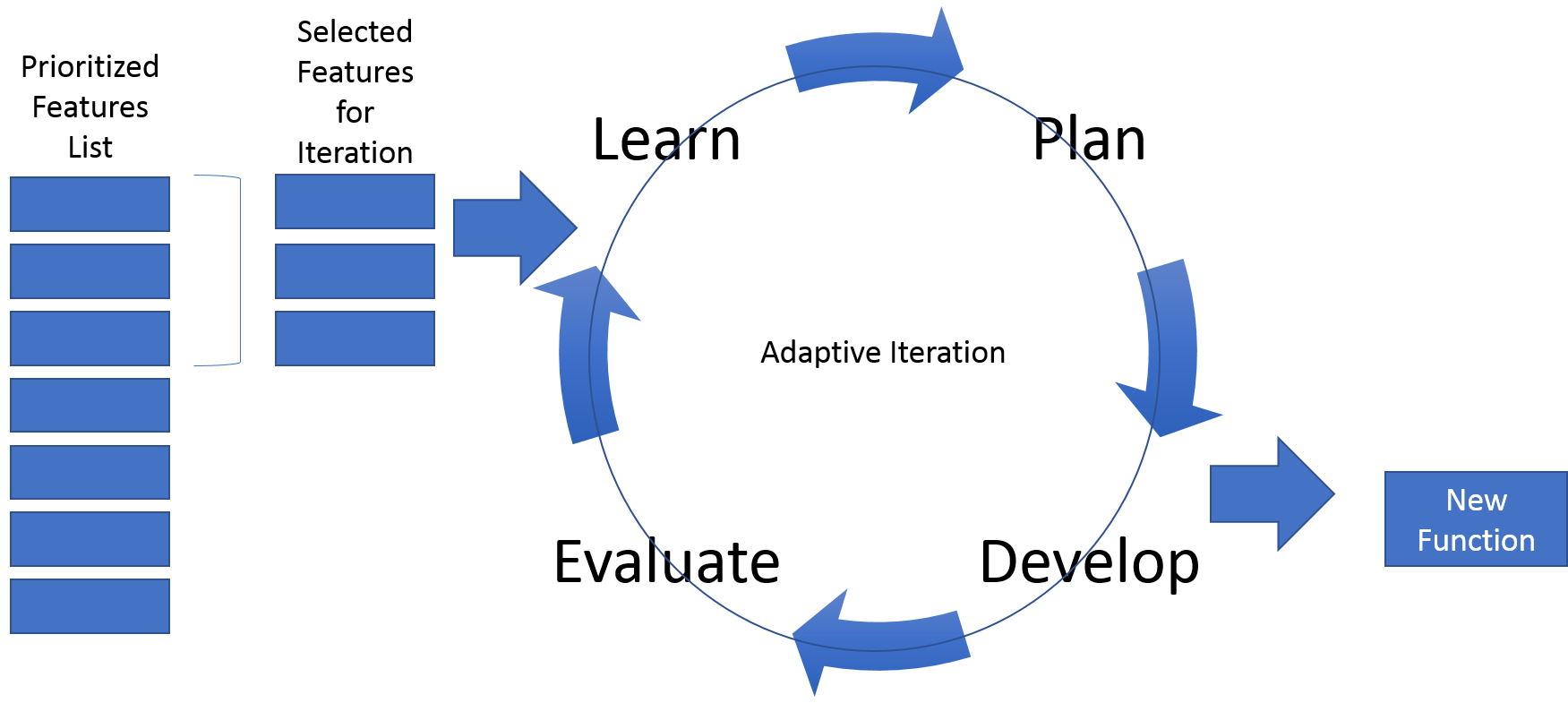
Adaptive Life Cycle (change-driven aka Agile) – Everyone wants rapid development these days, so when you need to execute a project fast, Agile is the way to go. This approach was built to handle changes and reduce inherent risk. The new PMBOK ®  Guide provides a whole appendix (Annex A3: Overview of Agile & Lean Frameworks, page 99) on the Agile/Lean approach. I highly recommend you read this Annex to better understand the concepts. Teams deliver software updates in weeks instead of months.

Adaptive projects are quick and time bound with two critical success factors:

  1. The customer must be intimately involved in the process and
  2. You must be able to define incremental requirements at the start of each iteration.

If requirements are not well known, like when you are developing a first of its kind application, the adaptive approach works nicely.

In addition to iterations being sequential, interactive, or overlapping, they could also run in parallel.  But don’t forget, especially when you are going at the speed of light, that each iteration should still be a complete cycle of Plan, Develop, Evaluate, and Learn. (Good project management process is all the more critical when you are going fast.) Iterations usually last 2 to 4 weeks at maximum.

To get a deeper understanding of all the concepts involved in Agile delivery, read the Agile Manifesto.

Hybrid Life Cycle – As it implies, the Hybrid takes the best of all approaches. You can use a predictive approach for the elements of the project that are known and an adaptive approach for the elements that will become apparent over time. “Hybrid methodologies accept the fluidity of projects and allow for a more nimble and nuanced approach to work,” says Jason Westland

Hybrid approaches are not new to project management, but they are definitely gaining acceptance as a way to solve life cycle problems in the 21st century. There is software coming on the market that allows you to blend approaches so you can manage different life cycle approaches all in one application. How neat is that?

Look for future posts on tips for choosing the best project life cycle approach. Feel free to comment below and I’ll do my best to answer your questions. Until next time, keep up the good attitude.

————————————————————————–
PMBOK® and PMP® are registered marks of the Project Management Institute, Inc.

Published November 10, 2017, on the IIL Blog